


DIY Indian Home Décor Ideas That Actually Work in a Living Room (No Craft Degree Required)
The DIY advice nobody gives you
Every DIY home décor guide eventually leads you to the same place: a hot glue gun, a pile of twine, and a project that looked effortless on screen and chaotic in your actual living room. The assumption baked into most of that content is that "doing it yourself" means making something from raw materials. But there's another way to read it — and for anyone drawn to Indian-aesthetic interiors, it's the more honest one.
When the objects themselves are handmade — carved by hand, strung by hand, painted by hand — your job isn't to manufacture anything. It's to curate, layer, and arrange. That's a skill, and it's one worth taking seriously.
Start with one anchor piece, not a mood board
The mistake most people make when decorating a living room is trying to execute a complete look all at once. They screenshot a dozen inspiration images, buy ten things, and end up with a room that looks assembled rather than lived in.
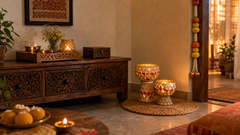
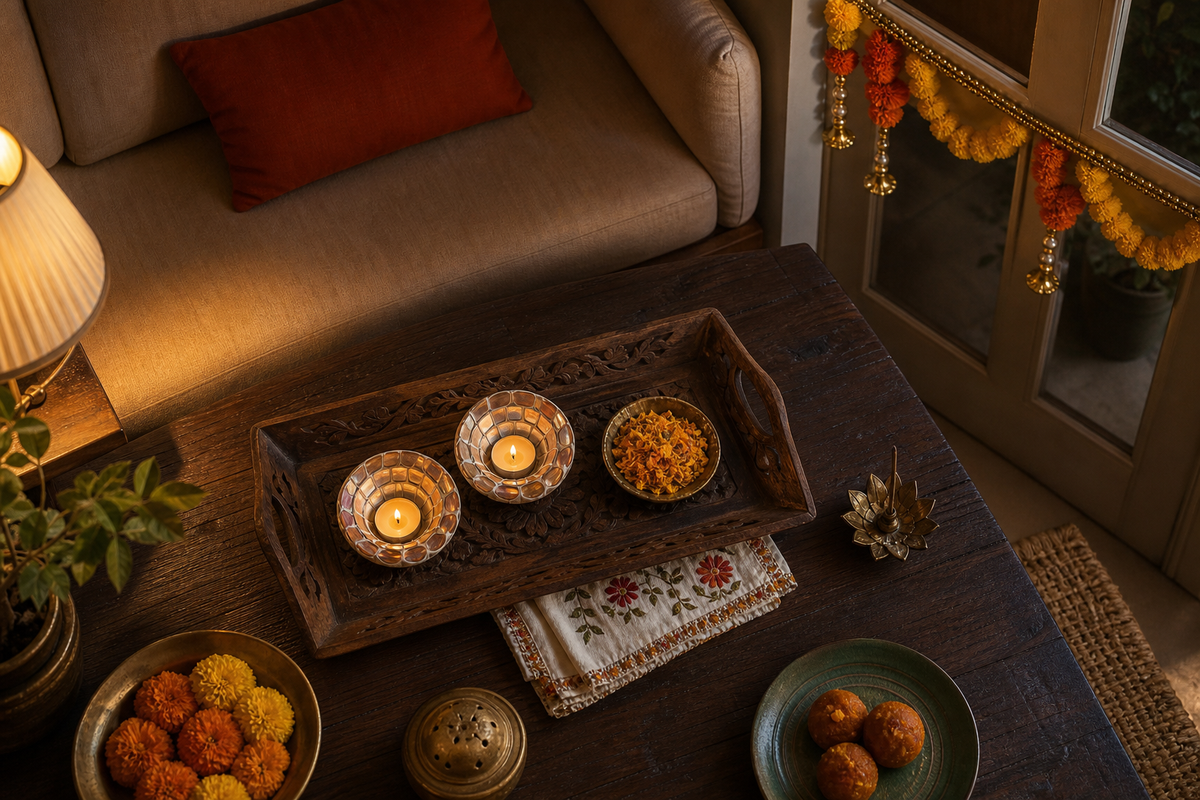
Pick one anchor piece first — something with enough visual weight that the room starts to orient around it. A hand-carved wooden tray placed on a coffee table, for instance, immediately signals a material and a texture. Everything you add after that is in conversation with it: a small brass bowl, a tea light holder, a folded textile. The room builds itself in layers, not in one shopping session.
This is where Indian craft objects have a genuine advantage over mass-produced décor. The irregularities in a hand-carved surface, the slight variation in a painted motif — these give a room depth that perfectly uniform objects can't. You're not covering for imperfection; you're displaying it.
The living room vignette: a practical framework
A vignette is just a small, intentional grouping of objects — the thing stylists do that makes a shelf or a corner look considered rather than cluttered. It sounds technical, but the logic is simple: vary the height, vary the texture, keep the palette tight.
Here's how that plays out with Indian craft objects specifically:
- Height variation: A tall, slender incense holder or a stacked set of decorative boxes gives the eye somewhere to travel vertically. Without it, everything sits flat and the grouping reads as clutter.
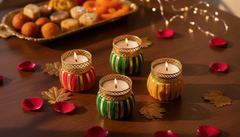
- Texture contrast: Pair a smooth lacquered surface with something woven or rough — a carved wooden piece next to a shell tea light holder, for example. The contrast is what makes each object more visible.
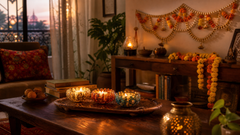
- A living element: Even a small handful of marigolds in a shallow bowl, or a single stem in a narrow vessel, anchors a vignette in the present moment. Artificial flower strings work well here too — the colour reads as warmth without the maintenance.
Three objects is usually enough. Five is the outer limit before it tips into display-case territory.
Doorways and entryways: the most underused space
In Indian homes, the threshold has always been a place of intention — a toran above the door, a rangoli at the entrance, a small diya on the step. That tradition translates directly into contemporary styling, and it works in apartments and rented homes just as well as in houses.
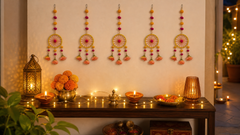
A marigold and pearl toran hung above a doorframe — even an interior doorframe between the living room and a hallway — immediately changes the character of a space. It's one of the few decorative gestures that's visible from across the room, which means it earns its place without crowding a surface. Pair it with a small tray below the door holding a tea light holder and a shallow bowl, and you've created an entry moment that feels deliberate without being fussy.
Lighting is the layer most people skip
Overhead lighting is functional. It's not décor. The rooms that feel warm and considered almost always have a secondary light source at a lower level — and this is where tea light holders do real work.
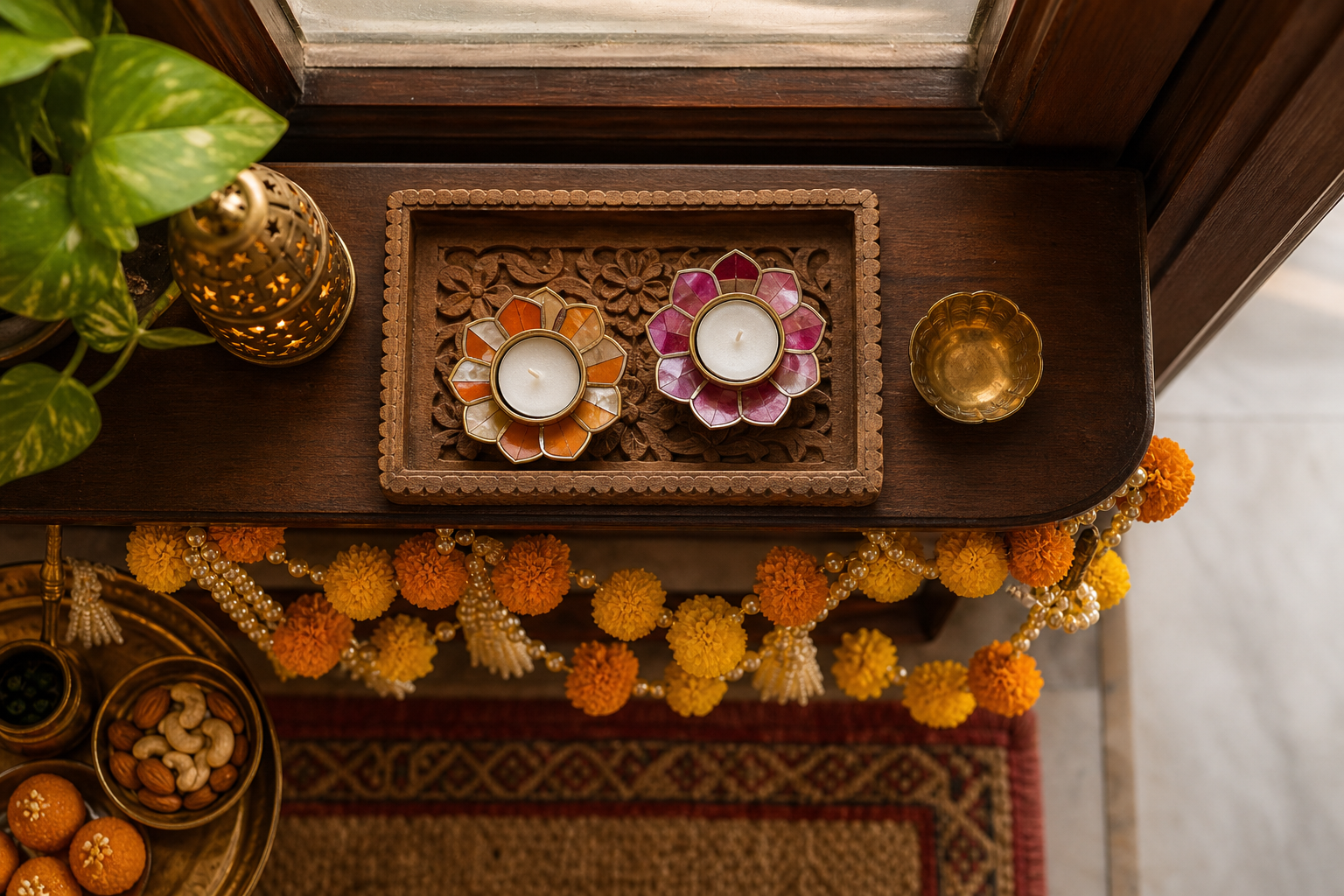
A set of shell tea light holders grouped on a side table or a window ledge creates ambient light that changes the mood of a room in a way that no cushion or throw can replicate. The light through a shell or a carved wooden holder isn't uniform — it scatters, it flickers, it creates shadow — and that movement is what makes a room feel inhabited rather than staged.
You don't need candles lit every evening. Even unlit, a grouping of holders reads as warmth because of what they imply.
Textiles and flat surfaces: a word of caution
Layering textiles — a runner on a console, a small embroidered cloth under a tray — is one of the quickest ways to add colour and pattern to a neutral room. But it's also where Indian-inspired interiors can tip into visual noise if you're not careful.
The rule that works: one patterned textile per surface. If the tray cloth has embroidery, the cushion behind it should be solid. If the wall hanging has colour, the shelf below it should be calm. Indian craft objects are already doing a lot of visual work on their own — they don't need to compete with each other.
Gifting and decorating are closer than you think
One practical upside of decorating with Indian craft objects: many of the best pieces are also the best gifts. A hand-embossed leather journal on a coffee table is a décor object and a thoughtful gift. A carved wooden serving tray styled with a small bowl of dried flowers is a centrepiece and a housewarming present waiting to happen. If you're decorating ahead of a festival or a gathering, you can often do both at once — style the room, then send the pieces home with guests.
If you're shopping for a couple during a festival like Raksha Bandhan, a practical guide to bhaiya-bhabhi gift sets can help you choose pieces that work as décor and as gifts simultaneously — which is a more useful frame than treating the two as separate decisions.
The honest summary
You don't need to make anything. You need to choose well, arrange deliberately, and resist the urge to fill every surface. Indian craft objects — a toran, a tea light holder, a carved tray, a flower string — carry enough craft in themselves that your job is mostly to get out of the way and let them breathe.
That's the DIY no one talks about: the discipline of restraint, and the confidence to let a single well-chosen object do more than a shelf full of average ones.
Browse StoreIndya's handcrafted décor collection to find the anchor pieces that give your living room a starting point worth building around.
Frequently Asked Questions
How do I style Indian décor in a living room that already has a neutral or modern look?
Neutral rooms are actually the best canvas for Indian craft objects — the contrast between a clean, minimal backdrop and a richly textured handmade piece is what makes each item stand out. Start with one or two objects (a carved tray, a tea light holder) and let the existing room breathe around them rather than trying to fill every surface.
Can I use festival décor like torans and marigold garlands year-round, or do they look out of place?
Torans and flower strings work year-round when you treat them as colour and texture rather than as festival signage. A marigold toran above a doorframe reads as warm and decorative in any season — it's the context around it (a full Diwali setup versus a simple, everyday arrangement) that signals whether it's festive or everyday décor.
How many objects are too many in a single vignette or shelf grouping?
Three objects is usually the sweet spot — enough to create visual interest, not so many that the eye doesn't know where to land. Five is a reasonable outer limit. Beyond that, even beautiful individual pieces start to cancel each other out. When in doubt, remove one thing and see if the grouping improves.
What's the easiest single change that makes a living room feel more intentional?
Add a secondary light source at a lower level — a tea light holder or a small lamp on a side table rather than relying only on overhead lighting. It's the change that stylists make first because it shifts the mood of a room immediately, and it works regardless of what else is in the space.
- DIY styling
- festive décor
- handcrafted
- home décor
- Indian décor
- living room