


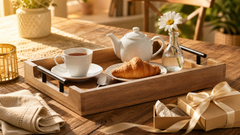
How to Decorate a Small Indian Home for Every Festival Without Buying New Decor Each Time
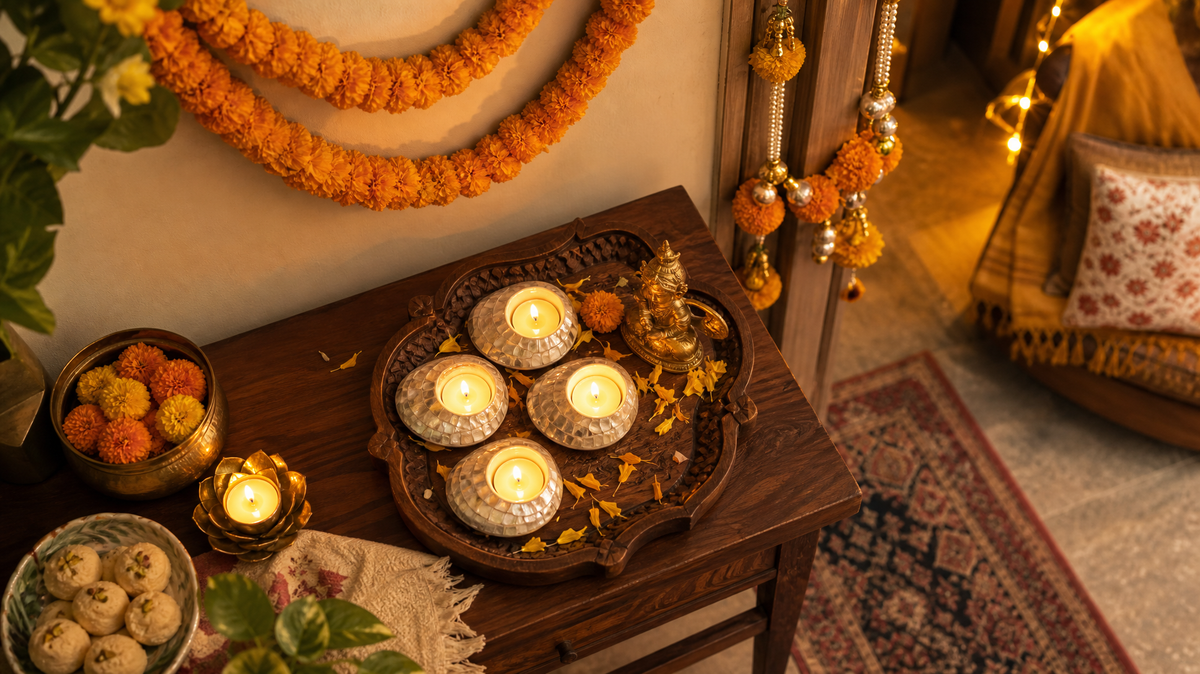
The cupboard problem nobody talks about
After every festival, there's that moment. You're folding up a plastic banner or stuffing a tangled string of lights into a bag you'll never find again, and you think: where is all this going to live? In a 2BHK or a studio flat, the answer is usually "on top of each other, in a box that's slowly taking over the bedroom."
The real issue isn't that you love decorating for festivals — you do, and you should. It's that most décor is bought for one occasion and then awkwardly retired. Diwali diyas that look out of place in February. Holi rangoli stencils that have nowhere to go until next March. The solution isn't to decorate less. It's to choose differently from the start.
A small set of well-chosen, handcrafted pieces can carry you through the entire festive calendar — Diwali, Navratri, Dussehra, Holi, Eid, Pongal — with nothing more than a rearrangement, a fresh flower, or a new candle. Here's how to build that set and actually use it.
Start with the entrance — it sets the tone for everything
In a compact home, the door and the entryway do a lot of heavy lifting. They're the first thing guests see, and in Indian festive culture, the threshold carries real significance — it's where you welcome Lakshmi, mark a new season, or signal that something celebratory is happening inside.
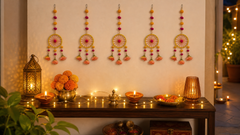
A toran is the most versatile thing you can hang here. A marigold and pearl toran, for instance, reads as auspicious for Diwali and Dhanteras, festive for Navratri, and welcoming for any religious ceremony or family gathering. The key is choosing one that's made to last — artificial marigold torans hold their colour and shape across multiple seasons, which means you're not buying a fresh one every Diwali.
The trick to making it feel different each time: change what's around it, not the toran itself. For Diwali, flank it with a pair of diyas on the floor. For Holi, swap in a vase of bright flowers on the side table. For Eid, keep it simple and clean. The toran stays; the context shifts.
The three objects that do the most work
If you're starting from scratch or trying to pare down what you already own, focus on three categories. These are the pieces that appear in almost every festival setup and can be rearranged endlessly without looking repetitive.
1. A set of tea light holders
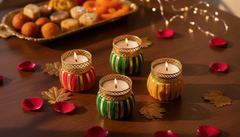
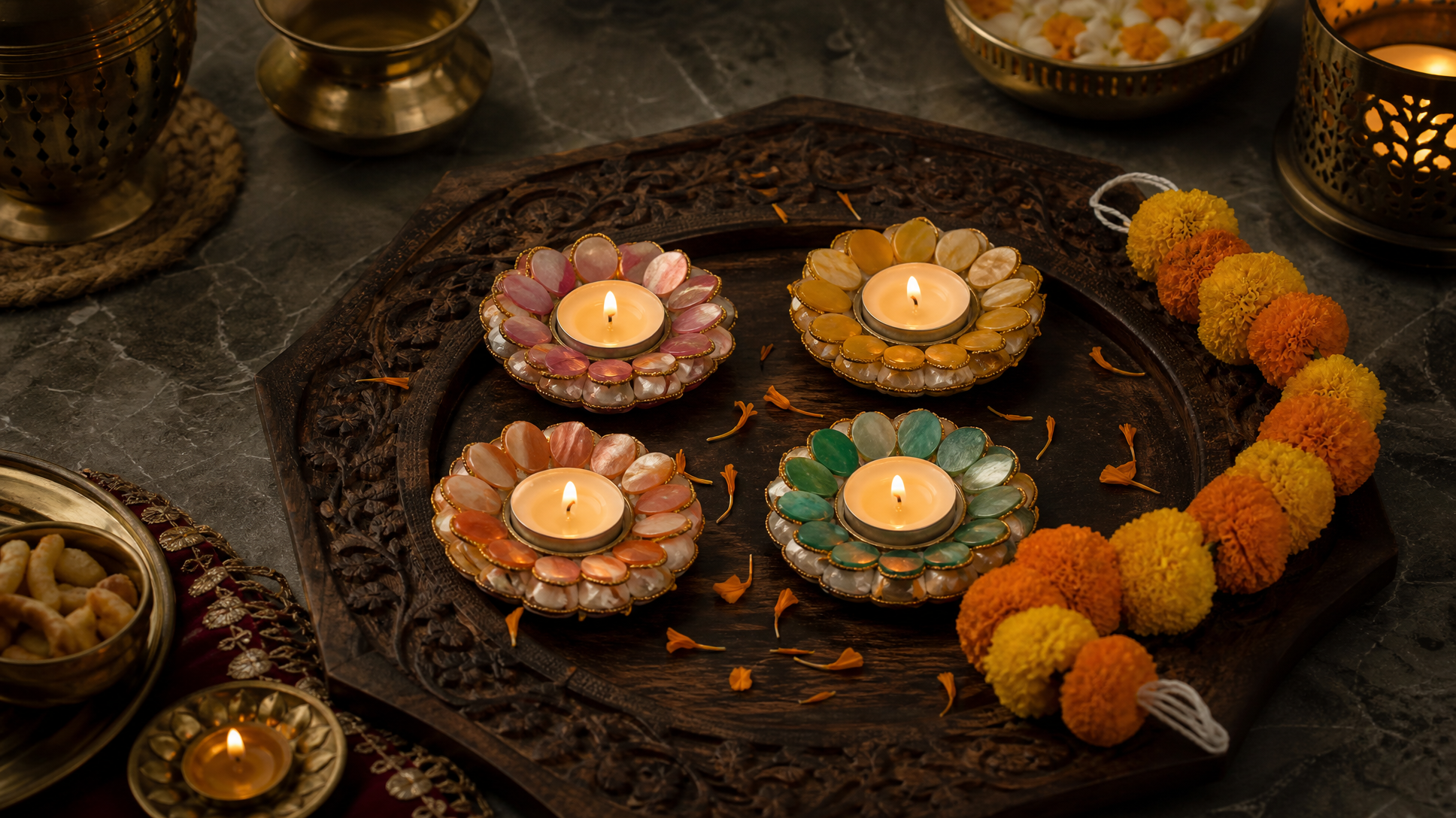
Candlelight is the one thing that makes any space feel festive, regardless of the occasion. Shell tea light holders — the kind with natural texture and varied colours — work on a puja thali for Navratri, clustered on a windowsill for Diwali, or placed along a dinner table for Eid or a family celebration. They're small enough to tuck into a drawer when not in use, and because they're genuinely decorative objects rather than purely functional ones, they don't look out of place even on an ordinary evening.
Buy a set of four. Arrange them in a line, a cluster, or a triangle depending on your surface. The same four holders will look completely different in each configuration.
2. Flower strings or garlands
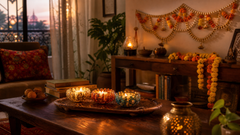
Marigold garland strings are probably the most underused versatile décor piece in Indian homes. Most people buy them for one event and then throw them away. If you choose artificial ones made with care — the kind that have real visual weight and colour — they can be draped over a mirror, looped around a pooja shelf, hung across a window, or laid along a mantle. Five-foot lengths give you enough to work with in a small room without overwhelming it.
For Diwali, drape them across the balcony railing. For Navratri, loop them around the garba space or the deity's frame. For a wedding anniversary or housewarming, they add warmth to a living room in minutes. Same strings, completely different mood.
3. A carved wooden tray
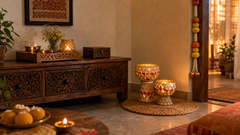
This one surprises people. A hand-carved wooden serving tray isn't obviously "festive décor" — which is exactly why it works year-round. During festivals, it becomes a puja thali surface, a candle arrangement base, or a styled vignette holder (toran, a small idol, a tea light). Outside of festivals, it's a breakfast tray, a bar tray, or a coffee table catch-all. It earns its space in a small home because it's never just one thing.
The key is choosing one with some visual character — carved handles, a warm wood tone — so it reads as intentional décor rather than purely utilitarian.
How to restyle the same pieces across four festivals
Here's what this actually looks like in practice, with a small home in mind.
Diwali: Hang the toran at the entrance. Cluster the tea light holders on the windowsill and the wooden tray. Drape garland strings across the balcony or along a bookshelf. Light everything at dusk. The home looks fully dressed in under twenty minutes.
Navratri: Move the garlands to frame the deity's space or the area where you set up for garba. Place the tea light holders around the base of the setup. The toran stays at the door — it's appropriate for nine nights of celebration. Add fresh flowers in a small vase if you want colour variation.
Holi: This is the one festival where the décor can afford to be minimal, because the colour and chaos happen outdoors. Keep the toran up if it suits the vibe, bring the wooden tray inside as a surface for gulal bowls or snacks, and let the garlands rest. Less is genuinely more here.
Eid or a family gathering: Style the wooden tray with the tea light holders and a small vase. Drape one garland string across a window or the dining area. Keep the entrance clean and welcoming. The pieces work because they're warm and handcrafted — they don't scream "specifically Diwali" or "specifically Hindu festival"; they just look like a home that cares about beauty.
The one rule for small spaces
Restraint is not the same as minimalism. In a compact home, the goal isn't to have as little as possible — it's to have nothing that doesn't earn its place. Every piece you keep should be able to do at least two jobs across at least two occasions. If it can only do one, it's storage debt.
Handcrafted pieces tend to pass this test more easily than mass-produced ones, because they have enough visual character to stand alone. A plain plastic garland needs to be part of a big display to look like anything. A well-made marigold toran looks intentional even by itself.
What to let go of
While you're building this smaller, harder-working collection, it's worth being honest about what's already in the cupboard. Single-use paper decorations, plastic banners with specific text ("Happy Diwali 2022"), anything that's faded or broken — these are the things taking up space without adding value. Letting them go isn't being unsentimental. It's making room for things that will actually get used.
If you're gifting home décor to someone with a small flat — and if you're looking for ideas, the same logic applies to choosing gifts for couples who are setting up a home — think about versatility first. The best gift is one that fits into their life across seasons, not just one occasion.
Build the kit once, use it for years
The upfront investment in a few well-made pieces pays off quickly when you stop buying and discarding every season. A toran that lasts three Diwalis, garland strings that come out for every puja, tea light holders that live on the coffee table year-round — that's the math that actually works in a small home.
Start with what you'll use most often, in the space you actually have. Add one piece at a time. And resist the urge to buy something new just because a festival is coming — the pieces you already have, rearranged and relit, are almost certainly enough.
Browse the festive décor collection at StoreIndya — handcrafted pieces designed to work harder than one occasion.
Frequently Asked Questions
Which Indian festival decorations work across multiple occasions without looking out of place?
Marigold torans, garland strings, and tea light holders are the most adaptable. They carry strong festive associations but aren't tied to a single occasion — a marigold toran is as appropriate for Diwali as it is for a housewarming, a puja, or Navratri. Carved wooden trays work even outside festival seasons as everyday serveware.
Are artificial marigold torans and garlands a good substitute for fresh flowers?
For everyday décor and repeated use across festivals, yes. Fresh marigolds are beautiful but wilt within a day or two, which makes them impractical for anything beyond a single event. Well-made artificial versions hold their colour and shape across multiple seasons, which is exactly what you want when you're trying to build a reusable décor kit rather than buying fresh each time.
How do I make a small living room feel festive without making it feel cluttered?
Work in zones rather than spreading décor across every surface. Pick two or three focal points — the entrance, a windowsill, the puja shelf or a side table — and dress those deliberately. Leave the rest of the room clear. Candlelight (via tea light holders) does a lot of the atmospheric work without taking up visual space, and a single draped garland reads as intentional rather than excessive.
What's a good starting set of handcrafted décor pieces for someone setting up their first home?
A toran for the entrance, a set of tea light holders, a length or two of garland strings, and a carved wooden tray will cover most festive occasions and double as everyday home accessories. These four categories give you flexibility across Diwali, Navratri, religious ceremonies, and family gatherings without requiring you to buy anything new each season.
- festival decor
- festive home styling
- handmade decor
- Indian home decor
- small home decor india