




Indian Home Decor Trends 2025: Why Handcrafted Natural Objects Are Replacing Printed Resin on Every Shelf
Something on your shelf has started to bother you
You can't quite name it, but you've noticed it. The little resin dish you bought three years ago — the one with the printed marble swirl — looks flat in a way it didn't before. Meanwhile, every interior you're saving to your phone has this quality of realness to it: visible grain, uneven edges, the sense that something was made by a person rather than poured into a mold.
That shift is real, and it's not just a mood. It reflects a genuine change in what people want from the objects they live with every day.
What's actually driving the move away from printed resin
Mass-produced resin and printed ceramics had a long run. They're affordable, consistent, and photograph cleanly. But consistency is also their problem — every piece looks exactly like every other piece, and after a while, a home full of them starts to feel like a showroom rather than a place someone actually lives.
The interiors gaining traction in 2025 lean the other way. Natural materials. Visible craft. Objects that carry the mark of the hand that made them. And within that broader shift, Indian artisan work has moved from "niche gift shop find" to a genuine reference point in how people are styling their shelves, entryways, and dressing tables.
Part of this is aesthetic. Carved wood, hand-hammered metal, and natural grain have a warmth that no printed surface can replicate. But part of it is also a reaction to years of identical interiors — the same white walls, the same geometric resin trays, the same everything. People want something with a story behind it.
What this looks like in practice: the catchall tray as a case study
The catchall tray is one of the smallest, most overlooked objects in any home. It sits on the entryway console, the nightstand, the bathroom counter — and it quietly holds the small daily things: a ring you took off, a key you'll need tomorrow, a chain you meant to put away. Most people have one. Almost nobody thinks about it.
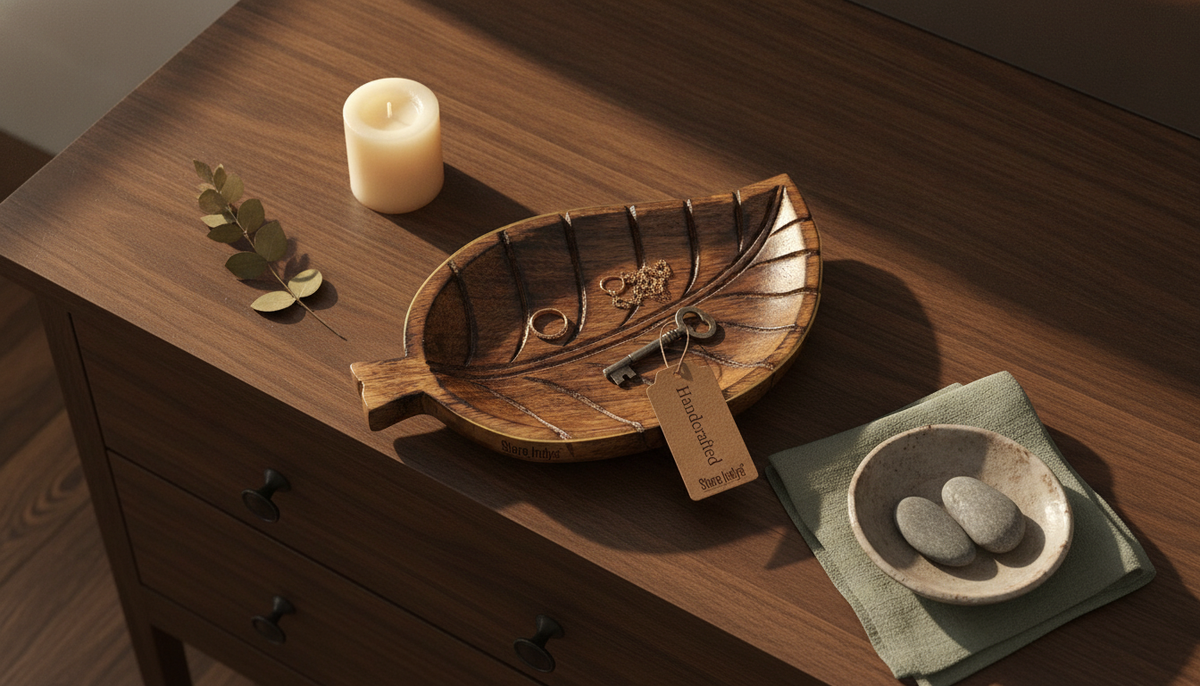
That's exactly why it's such a good lens for this trend. When a tray is a flat resin square with a printed pattern, it does its job and disappears. When it's something like Store Indya's handcrafted leaf-shaped wooden tray, it becomes the thing your eye goes to first when you walk into a room.
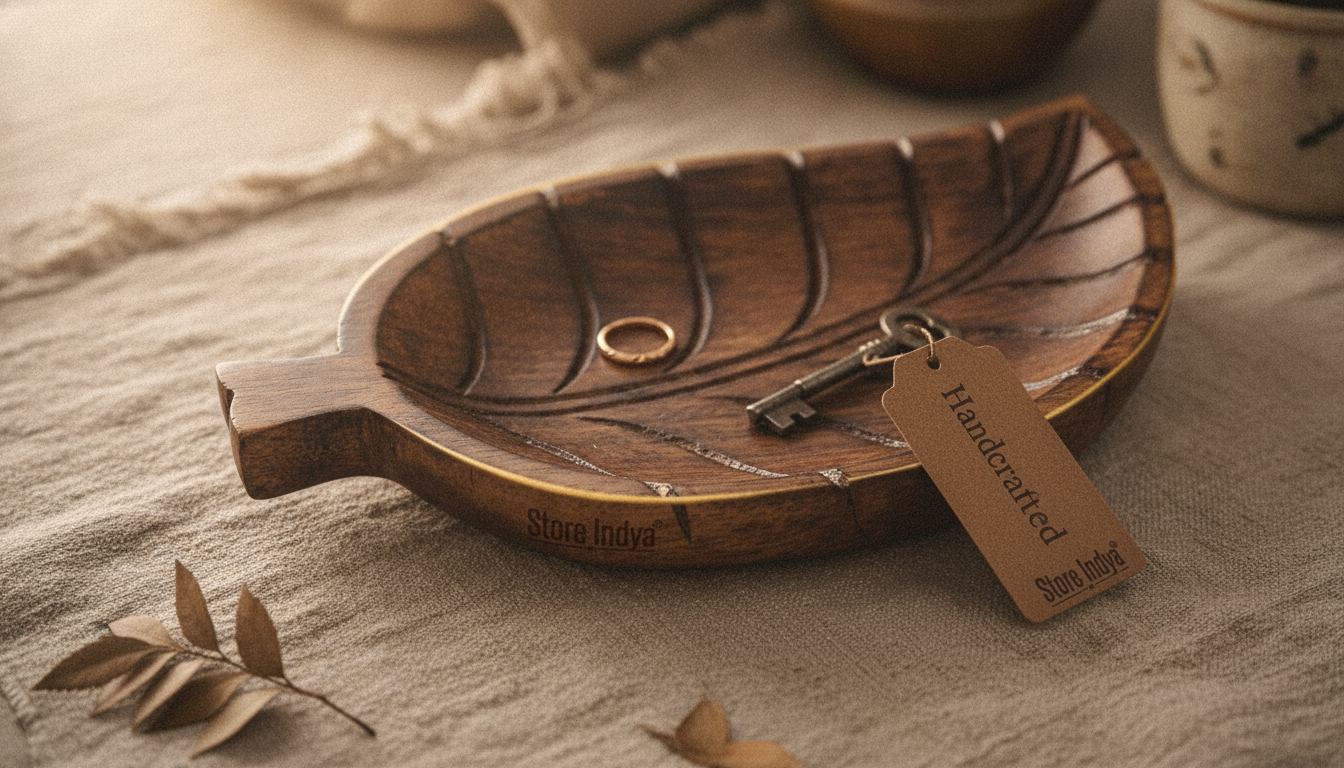
The tray is carved from wood into the shape of a leaf — not a simplified, stylized leaf, but one with actual vein detailing hand-carved into the surface, following the natural grain of the wood beneath it. The rim is finished in gold-tone metal, which keeps the edge clean while adding just enough contrast to make the dark wood read as intentional rather than rustic-by-accident. It's the kind of object that looks like it was placed on a dresser for a photo shoot, but it's also genuinely useful — holding a ring, a necklace, a small key, whatever lands in your pocket at the end of the day.
That combination — something beautiful enough to display and functional enough to actually use — is the heart of what makes artisan-made pieces work in modern interiors. They don't ask you to choose between form and function.
Why Indian craftsmanship specifically
Indian woodcarving has centuries of tradition behind it, and the techniques that produce something like the leaf tray's vein detailing aren't learned quickly. The depth of the carving, the way it follows the grain rather than fighting it, the hand-finishing that gives each piece its own slightly different character — none of that happens in a factory setting.
What's changed is access. Brands like Store Indya have made it straightforward to bring these pieces into a home anywhere in the world, without having to track down a craft market or rely on a relative who happens to be traveling. The craft itself isn't new; what's new is how easy it is to find.
And the objects themselves translate well. A leaf-shaped wooden tray doesn't read as "culturally specific" in a way that requires context to appreciate — it reads as beautiful, which is a language everyone speaks.
Five places this tray actually earns its spot
- The entryway console — keys, sunglasses, a small candle. The gold rim catches the light from the door.
- The nightstand — rings and earrings you take off before bed, so they're in one place in the morning.
- A bathroom shelf — small hair clips, a hair tie, a lip balm. The wood adds warmth to a space that's usually all tile and chrome.
- A coffee table — a few decorative stones or a small succulent sitting in the leaf's natural hollow.
- A home office desk — paper clips, a USB drive, a small pen. It's a desk accessory that doesn't look like a desk accessory.
The shelf test
Here's a simple way to think about whether an object belongs in your space: if you removed it, would the shelf look emptier, or just cleaner? A resin tray, honestly, usually falls in the second category. Something handcrafted — with real grain, real carving, real variation — tends to fall in the first. Its absence is felt.
That's the standard worth holding objects to. Not whether they're on trend, but whether they'd actually be missed.
If you're ready to start that shift, explore Store Indya's handcrafted wood collection at storeindya.com — the leaf tray is a good place to begin.
Frequently Asked Questions
Is the leaf tray suitable for actually serving food, or is it decorative only?
It's designed to be multipurpose — the product is described as both a trinket organizer and a serving tray. That said, as with any natural wood piece, it's worth keeping it away from prolonged moisture or direct contact with very wet foods. It works well for dry snacks, appetizers, or as a display surface for small decorative items.
Will two of these trays look exactly the same?
No — and that's part of the point. Because each tray is handcrafted from natural wood, the grain pattern and the depth of the carving will vary slightly from piece to piece. No two are identical, which is a feature of genuine artisan work rather than a flaw.
Does this make a good gift?
It's one of the more straightforward gifting decisions in the home décor category — it's useful, it's beautiful, and it doesn't require the recipient to already own something specific for it to make sense. It works as a housewarming gift, a birthday present, or a thoughtful addition to a festival gifting set. The kraft paper "Handcrafted" tag it comes with also adds a nice unboxing touch.
How do I care for a handcrafted wooden tray like this?
General guidance for natural wood pieces: wipe with a dry or barely damp cloth rather than soaking it, keep it out of direct sunlight for extended periods to preserve the finish, and avoid leaving wet items sitting on it. Occasional light oiling with a food-safe wood oil can help maintain the wood's appearance over time, though always check the product's own care instructions first.
- artisan decor
- handcrafted decor
- home decor trends 2025
- indian home decor
- trinket organizer
- wooden tray