


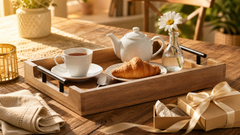
Indian Home Décor Trends Worth Paying Attention to Right Now
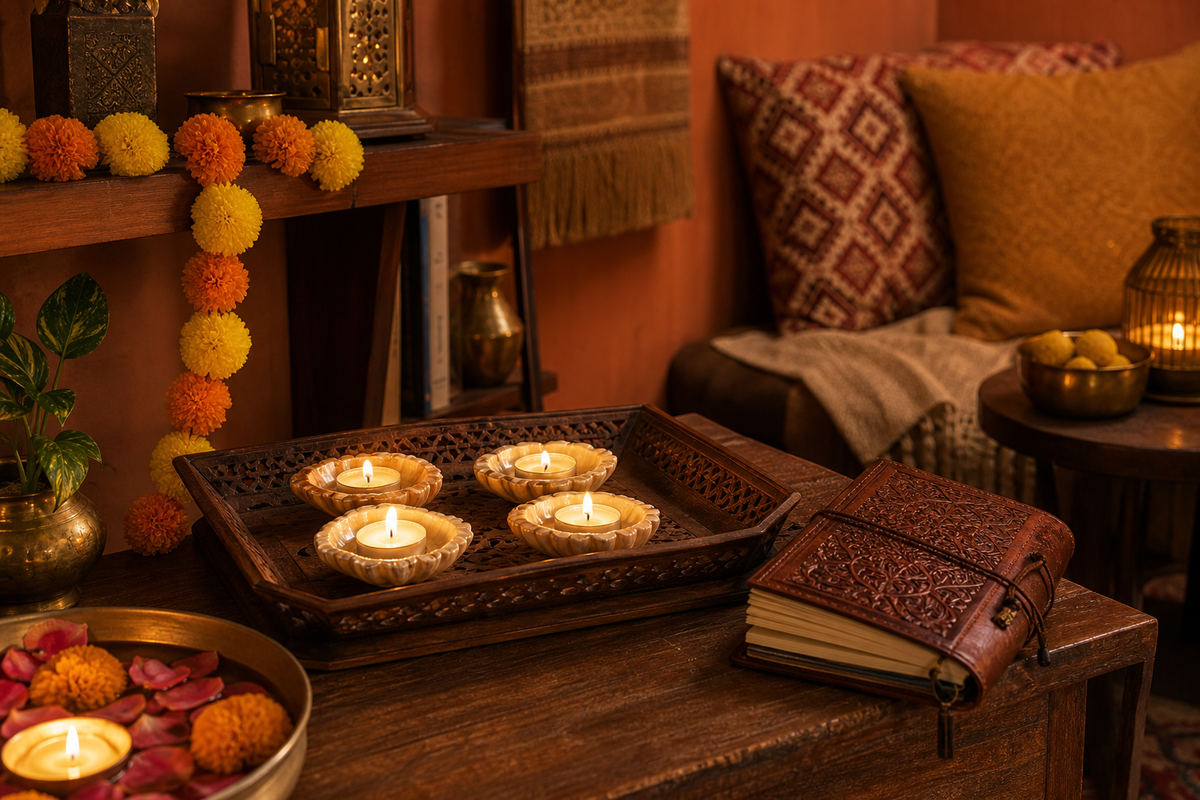
The Gap Between Mood Boards and Real Homes
There's a version of "Indian home décor" that lives exclusively on Pinterest — maximalist, museum-dense, every surface draped in brocade. Then there's how most of us actually live: a rented flat, a newly bought apartment, or a family home that's slowly being made your own, one considered piece at a time. The interesting design conversation is happening in that second space.
What's shifted in the last few years isn't a rejection of traditional Indian aesthetics — it's a recalibration. People aren't choosing between "modern" and "traditional"; they're asking how a hand-carved tray or a string of marigolds can sit naturally in a home that also has clean lines and neutral walls. The answer, it turns out, is that it can — and often better than a mass-produced accent piece from a generic furniture chain.
Here are the directions actually worth following.
Warm Neutrals as a Base, Craft as the Colour
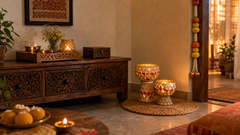
The all-white interior is quietly being replaced by warmer, earthier base tones — terracotta, warm sand, aged linen. These palettes do something useful: they stop competing with handmade objects and start setting them off. A carved wooden serving tray on an off-white kitchen shelf reads like it belongs there. The same tray on a stark white surface can look like a prop.
If your walls and larger furniture are already trending toward warm neutrals, you're halfway to making traditional craft objects feel intentional rather than incidental. The craft becomes the colour story, not an afterthought.
The Return of the Threshold
One of the most underrated shifts in how Indian homes are being styled is renewed attention to the entrance — the door, the threshold, the first thing a guest sees. This isn't purely aesthetic; there's a deep cultural logic to it that's finding a new audience in younger homeowners who want their spaces to feel rooted.
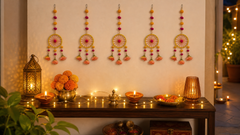
Marigold torans and door hangings are showing up not just during Diwali or weddings but as semi-permanent fixtures, swapped out seasonally the way a wreath might be in other design traditions. An artificial marigold and pearl toran, for instance, holds its colour and form without wilting — which makes it a practical choice for someone who wants the look without the daily upkeep of fresh flowers. The entrance becomes a quiet signal of how the rest of the home is styled.
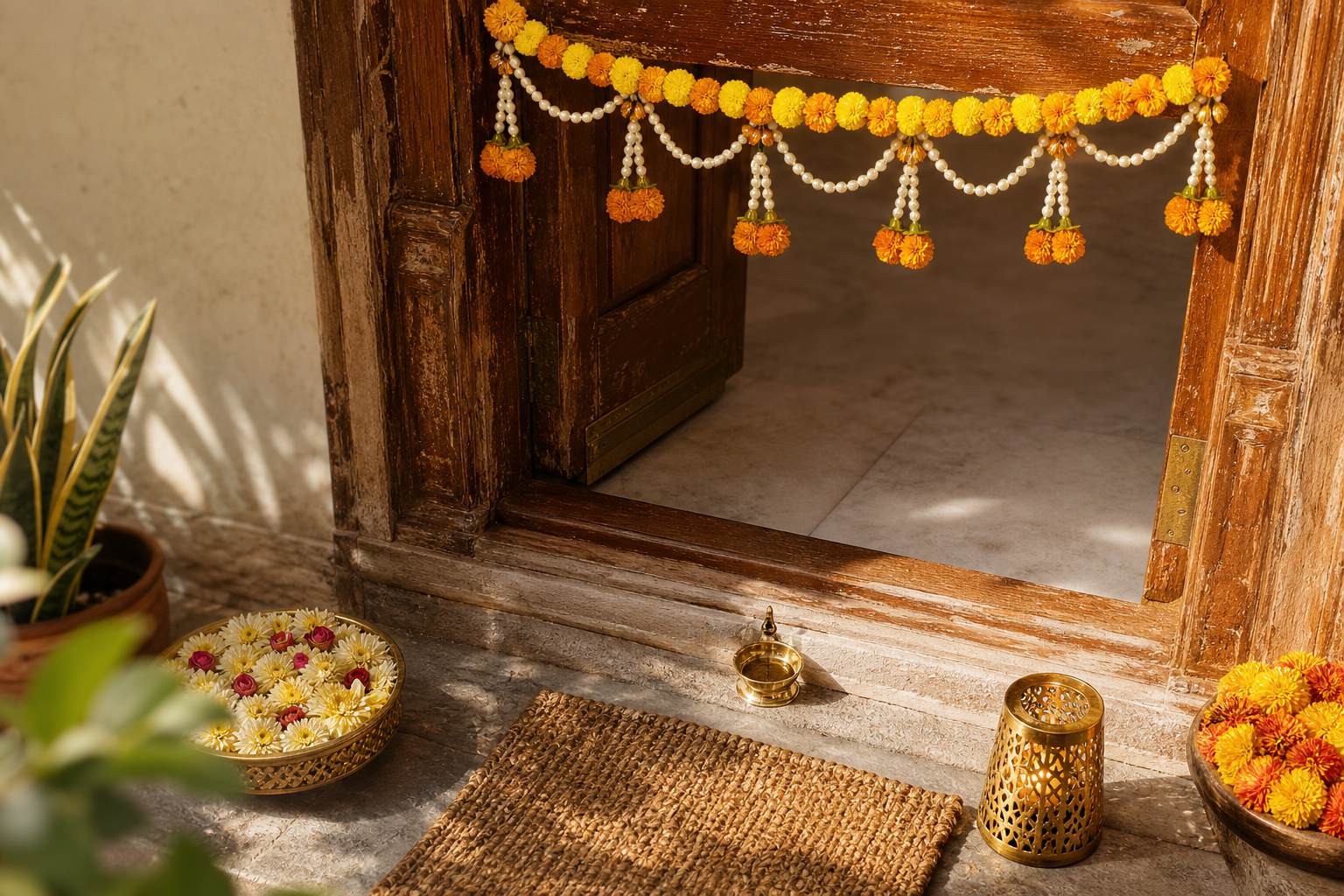
Candlelight Is Having a Serious Moment
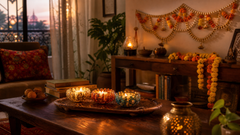
Ambient lighting — specifically warm, flickering candlelight — has moved from "festive occasion only" to a genuine part of how people style their living rooms and dining tables on an ordinary Tuesday. The global wellness conversation around screens and blue light has something to do with it, but so does a broader aesthetic shift toward softness and warmth in interiors.
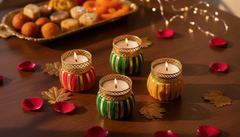
This is where handmade tea light holders earn their place in a non-festival context. Shell or artisan-crafted holders scatter light differently than a plain glass votive — the texture catches the flame and creates movement on the wall behind them. Grouped in threes or fours on a sideboard or dining table, they do the work of expensive mood lighting for a fraction of the effort. It's one of those cases where the traditional object is actually the smarter design choice, not just the sentimental one.
Garlands as Interior Objects, Not Just Occasion Décor
Flower garlands and strings have a long history in Indian domestic life — draped over frames, hung in puja rooms, strung across doorways for celebrations. What's newer is seeing them used as deliberate interior styling elements in living spaces that aren't set up for a specific occasion.
A string of artificial marigolds draped along a bookshelf edge, looped around a mirror frame, or hung across a window brings colour and texture without requiring a nail or a significant commitment. The key is scale and restraint: one well-placed garland reads as intentional; five competing ones read as decoration from a party that never quite ended. Used sparingly, they're one of the most flexible and affordable ways to bring warmth into a room.
Handmade Objects as the Antidote to Algorithm Interiors
There's a growing fatigue with spaces that look like they were assembled from the same three online retailers — beautiful in a photograph, but oddly identical to every other "curated" home on your feed. Handmade objects break that pattern in a way that mass-produced décor simply can't, because no two are exactly alike.
A hand-embossed leather journal on a desk, a hand-carved wooden tray on a kitchen counter — these aren't just functional; they carry the evidence of someone making them. That's increasingly what people are looking for in their homes: objects that have a story legible in the object itself, not just in the marketing copy around it.
This is also why Indian craft traditions are particularly well-suited to this moment. The techniques — wood carving, embossing, shell work — produce objects with visible texture and variation that photographs well but feels even better in person. In a design era that's hungry for authenticity, that's not a small thing.
Gifting as a Design Category
One pattern worth noting: many of the handcrafted pieces showing up in well-styled Indian homes arrived as gifts. A carved tray from a housewarming, a set of tea light holders from Diwali, a leather journal from a thoughtful friend. This isn't accidental — it reflects how Indian gifting culture and home décor culture are genuinely intertwined.
If you're shopping for someone who takes their home seriously, a well-chosen handcrafted piece is often more welcome than another scented candle or generic hamper. And if you're building your own space, it's worth thinking about the objects you give and receive as part of a longer design conversation — not one-off purchases but pieces that accumulate into a home with a point of view. For Raksha Bandhan specifically, this guide to bhaiya-bhabhi gift sets is a useful starting point if you're thinking about home-focused gifting for couples.
Where to Start If You're Styling From Scratch
You don't need to overhaul a room. The most effective approach is usually one anchor piece — something with enough presence to set a direction — and then two or three smaller objects that echo it. A carved wooden tray anchors a kitchen or dining space; a pair of tea light holders on the same surface reinforces the material story. A toran at the entrance sets a tone that carries through even before a guest steps inside.
Start with the spaces you actually use and see every day. The entrance, the dining table, the shelf you pass every morning. That's where a well-chosen handcrafted object does its best work — not in a room you've decorated for a photoshoot, but in the life you're actually living.
Browse StoreIndya's handcrafted home décor collection to find pieces that fit how Indian homes are actually being styled today.
Frequently Asked Questions
How do I style traditional Indian décor in a modern, minimalist home without it looking cluttered?
The key is restraint and intention. Choose one or two anchor pieces with strong craftsmanship — a carved wooden tray, a set of tea light holders — and give them space to breathe rather than grouping every traditional object you own. A warm neutral base (walls, textiles, furniture) lets handmade pieces stand out without competing with each other.
Can artificial marigold torans and garlands be used year-round, or are they only for festivals?
Absolutely year-round. Artificial marigold torans and garlands hold their colour and shape without wilting, which makes them a practical choice as semi-permanent décor — swapped out seasonally rather than tied to a single occasion. Many homeowners now use them at the entrance or draped along shelves as an everyday styling element, not just for Diwali or weddings.
What makes handmade Indian décor objects different from mass-produced alternatives?
Handmade objects carry visible evidence of their making — the slight variation in carving, the texture of embossed leather, the irregularities in shell work. No two pieces are exactly alike, which means your space won't look identical to everyone else's. That distinctiveness is increasingly what people are looking for as a counterpoint to algorithm-driven, trend-identical interiors.
Are handcrafted home décor pieces a good gift option for someone who already has a well-styled home?
Often better than a generic gift, yes. A well-chosen handcrafted piece — a carved tray, a leather journal, a set of artisan tea light holders — fits into a considered home more naturally than mass-produced alternatives, precisely because it has character and specificity. It also signals that you paid attention to what the recipient actually values in their space.
- festive décor
- gift ideas
- handmade décor
- Indian craftsmanship
- Indian home décor
- living room decor ideas indian