


Vastu Tips for Positive Energy in Your Home: Which Craft Objects to Place Where
Most people hang a toran, light a diya, and hope for the best.
That's not a criticism — it's just how most of us learned to decorate for good energy. Someone in the family said the entrance should have a door hanging, or that lamps belong near the puja corner, and we followed along without quite knowing why. Vastu Shastra, the ancient Indian system of spatial arrangement, actually gives those instincts a structure. And when you understand the logic, choosing where to place a handcrafted object becomes as meaningful as choosing the object itself.
This isn't a lecture on Vastu theory. Think of it as a practical room-by-room map — the kind you can actually use the next time you're deciding where to hang something or where to set a decorative piece you just brought home.
The Entrance: Your Home's First Impression on Energy
In Vastu, the main door is where prana — life force — enters your home. What greets it matters. A cluttered, dark, or bare entrance is considered one of the fastest ways to let positive energy dissipate before it even gets inside.
The northeast and north-facing entrances are considered especially auspicious in Vastu. For any entrance, the guidance is consistent: keep it well-lit, unobstructed, and visually welcoming. This is exactly why the tradition of hanging a toran above the main door has survived for thousands of years — it's not just decorative, it's intentional.
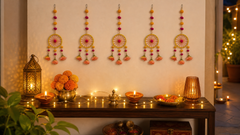
A marigold toran, particularly one with pearl accents, signals abundance and welcome. The colour orange and yellow are associated with warmth and positive vibrations in Indian tradition. Hang it at the top of the doorframe so it's visible the moment someone approaches. Pair it with a small oil lamp or diya near the threshold — placed to the right of the door as you enter — to keep the energy bright and active.
What to place here: Door torans, flower strings, diyas or tea light holders near the threshold. Keep the space clean and lit.
The Puja Room or Prayer Corner: Precision Matters Most Here
If there's one room where Vastu guidance is most specific, it's the puja space. The northeast corner of your home — sometimes called the Ishan kona — is considered the most spiritually charged zone. Vastu recommends placing your prayer altar or puja corner here whenever possible.
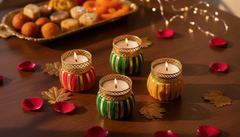
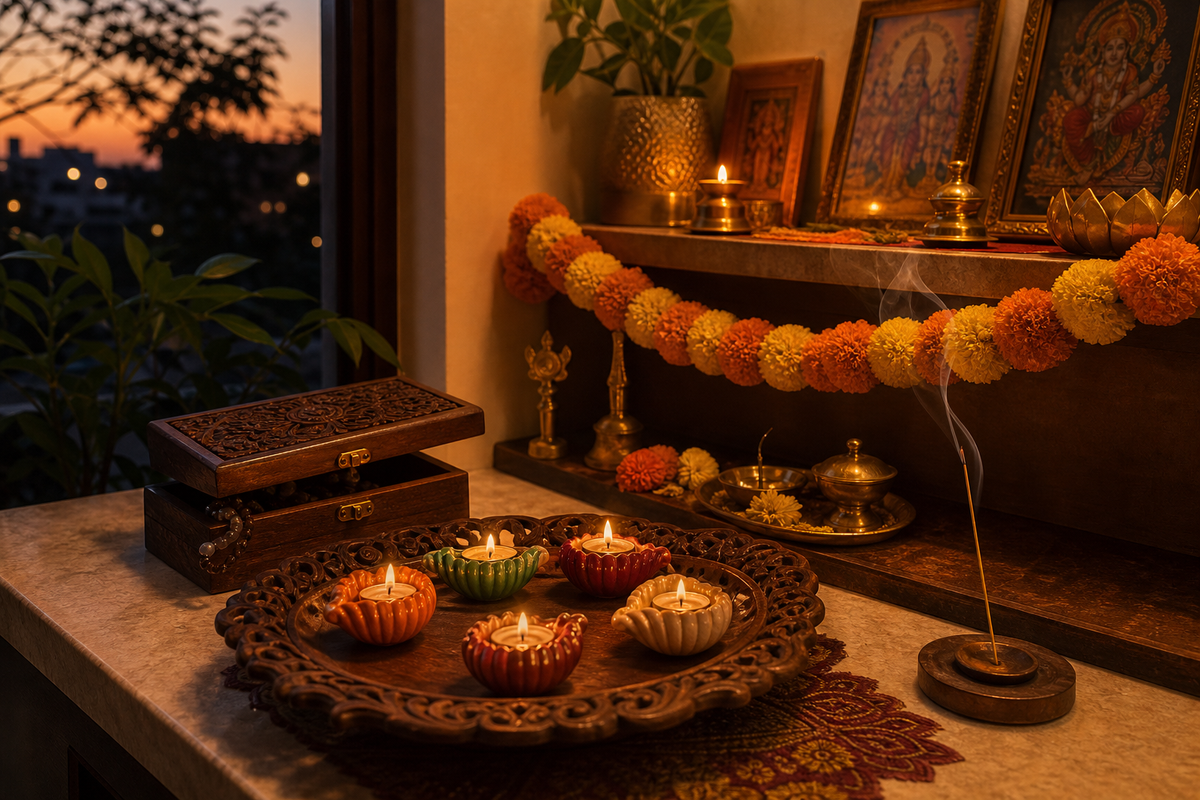
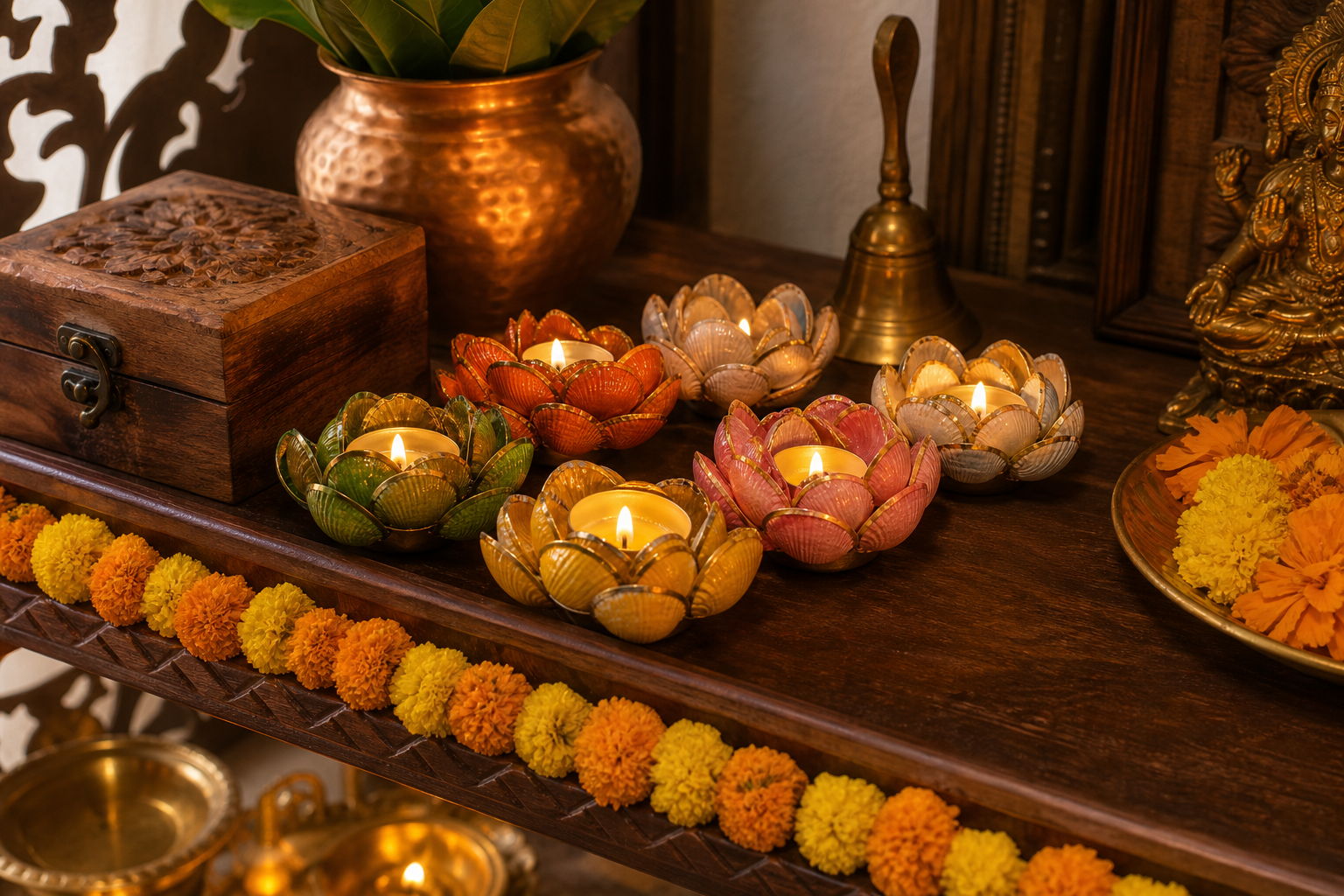
Within this space, the objects you choose and how you arrange them carry weight. Diyas and candle holders should be placed in the southeast direction of the puja area, which is associated with the fire element (Agni). Shell tea light holders work beautifully here — the natural material has its own grounded, organic quality that sits well in a devotional space.
Incense holders belong on the northeast side of the altar, helping carry intention upward. Avoid cluttering the puja corner with too many objects; Vastu consistently favours openness and intentional placement over abundance for its own sake.
What to place here: Tea light and candle holders (southeast of the altar), incense holders (northeast), small decorative brass or wooden boxes for storing sacred items. Keep the floor and surface beneath the altar clean and unobstructed.
The Living Room: Where Energy Gathers and Circulates
The living room is where energy doesn't just enter — it moves, collects, and ideally, stays. Vastu recommends keeping this space open and balanced, with heavier decorative objects placed along the south and west walls, and lighter, more energising pieces toward the north and east.
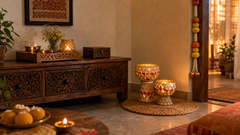
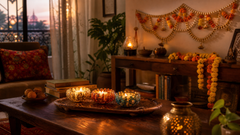
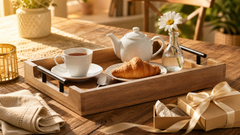
Wooden décor fits naturally here. A hand-carved wooden tray displayed on a coffee table or sideboard brings the earth element into the room, which Vastu associates with stability and grounding. If you're using it as a functional piece — for serving, for organising remotes, for holding a candle cluster — it earns its place twice over.
Wall hangings and woven textiles work well on the south wall. Avoid hanging anything heavy or dark on the north wall, which is associated with prosperity and should ideally remain light and open.
One often-overlooked tip: Vastu advises against placing decorative objects in corners where they gather dust and stagnate. If you have a beautiful piece in a corner, make sure it's accessible, occasionally moved, and kept clean.
What to place here: Carved wooden trays and serving pieces on the centre table or sideboard, wall hangings on the south or west walls, flower garlands draped along a mantle or shelf for a festive touch.
The Kitchen and Dining Area: Honour the Fire Element
The kitchen sits under the dominion of Agni — fire — and Vastu places it ideally in the southeast corner of the home. The dining area, where nourishment is shared, benefits from warm, earthy tones and natural materials.
Wooden serveware and trays are a natural fit here, not just functionally but energetically. Natural wood is considered grounding and warm; using it in a space dedicated to food and family reinforces the sense of abundance Vastu encourages in dining areas.
Avoid keeping broken, chipped, or unused decorative objects in the kitchen — Vastu is firm on this. An object that no longer serves a purpose shouldn't occupy space where active, nourishing energy is generated.
What to place here: Wooden trays and bowls on the dining table or counter, warm-toned candle holders for evening meals. Keep the space functional and uncluttered.
The Study or Workspace: Activate the North
The north direction in Vastu is governed by Kubera, the deity of wealth and prosperity, and is considered ideal for workspaces and study areas. Keeping the north wall of your study light, open, and free of heavy furniture or dark décor is a foundational Vastu recommendation.
For a desk or study corner, a leather journal or a decorative wooden box for storing stationery brings both practicality and intentionality. In Vastu, having a designated, beautiful place for important papers and tools is considered conducive to focused, productive energy — the opposite of scattered papers and a cluttered surface.
A small plant or a single tea light holder on the desk (northeast corner of the desk surface, if possible) keeps the energy active without overwhelming the workspace.
What to place here: Leather journals and decorative boxes on the desk, a single candle or tea light holder in the northeast corner of the desk surface. Keep the north wall clear.
The Bedroom: Calm, Not Stimulating
Vastu's guidance for bedrooms runs counter to what many people do: it advises against placing too many decorative objects, especially anything with sharp edges, mirrors facing the bed, or overly bright or stimulating décor. The bedroom is for rest and restoration.
That said, a few well-chosen pieces genuinely contribute to a calm atmosphere. Soft flower strings or garlands draped over a headboard or along a window create warmth without visual noise. A small wooden box on the bedside table — for jewellery, for a few meaningful items — keeps surfaces tidy and grounded.
The southwest corner of the bedroom is considered the most stable zone in Vastu — ideal for the bed itself, and for any heavier decorative pieces you want to anchor the room.
What to place here: Soft flower garlands or strings for warmth, a small wooden or decorative box on the bedside table. Avoid cluttering surfaces; less is genuinely more here.
One Principle That Ties All of It Together
Vastu isn't about filling every corner with auspicious objects. The system's underlying logic is about flow — of light, air, and intention. A single handcrafted piece placed thoughtfully, kept clean, and chosen for its material and meaning will do more for the energy of a room than ten decorative items arranged without thought.
The craftsmanship of an object matters too. Handmade pieces carry the energy of the maker — that's not mysticism, it's the difference you feel when you hold something made with care versus something mass-produced. Natural materials like wood, shell, and dried flowers connect a space to the earth element that Vastu consistently returns to as foundational.
If you're ready to start placing with intention, explore the handcrafted décor at StoreIndya — from marigold torans and tea light holders to carved wooden trays and leather journals, each piece is designed to feel at home in a space you've thought about.
Frequently Asked Questions
Which direction should a toran be hung according to Vastu?
A toran should be hung at the top of the main entrance door. In Vastu, the main door is the primary entry point for positive energy into the home, so the toran's placement here is both traditional and intentional. Ensure the entrance itself is well-lit and unobstructed for best effect.
Can I place diyas or candle holders anywhere in the home?
Vastu associates fire and light with the southeast direction, which is governed by the fire element (Agni). Placing diyas and candle holders in the southeast corner of a room or altar is considered most auspicious. Near the entrance and in the puja corner are also traditional placements. Avoid placing them in the northeast corner of the overall home, which is reserved for water and spiritual energy.
Are artificial flower garlands considered acceptable in Vastu, or should they be real flowers?
Vastu texts traditionally refer to fresh flowers, but the practical guidance most Vastu consultants offer today is that the key factors are cleanliness and positive visual energy — not whether the flowers are fresh or artificial. High-quality artificial marigold garlands that look vibrant and are kept dust-free are widely used and considered acceptable. The important rule is to replace or clean any garland that looks faded, dusty, or worn.
Is there a Vastu rule against keeping decorative objects in the bedroom?
Vastu doesn't prohibit bedroom décor, but it does advise keeping the bedroom calm and uncluttered. Avoid mirrors facing the bed, overly bright or stimulating colours, and too many decorative objects on surfaces. A few grounding, natural-material pieces — a wooden box, soft garlands — are considered fine and even beneficial for creating a restful atmosphere.
- festive décor
- handcrafted décor
- home arrangement
- Indian home décor
- positive energy
- Vastu tips