


What Are Living Room Accessories? A Practical Answer for Anyone Decorating With Indian Style
The question sounds simple. The answers usually aren't.
Type "what are living room accessories" into any search engine and you'll get the same recycled list: scatter cushions, a vase, maybe a rug. Technically correct, thoroughly useless if you're trying to decorate a home that actually reflects something — a heritage, a sensibility, a culture.
If you're drawn to Indian craft aesthetics — the warmth of marigold yellows, the texture of hand-carved wood, the soft flicker of a tea light through a shell — that generic list tells you almost nothing about how to make a living room feel genuinely alive. So here's a more honest answer, built around what accessories actually do in a room, and which handcrafted Indian forms do each job best.
What "living room accessory" actually means
An accessory, in decorating terms, is anything that isn't furniture or fixed architecture but still shapes how the room looks and feels. It's the layer that turns a functional space into one with personality. The reason most lists feel hollow is that they describe categories without explaining the function — and function is exactly what you need to understand before you buy anything.
Every living room accessory does one of four things: it anchors the eye on a wall, it gives a surface a reason to exist, it controls light and atmosphere, or it adds softness and movement. Once you know which job needs doing in your room, choosing the right piece becomes much more straightforward.
Wall anchors: giving vertical space a voice
A bare wall doesn't just look unfinished — it makes the furniture below it feel unmoored. Wall accessories fix this by creating a visual destination. In Indian craft tradition, this role has long been filled by textile hangings, mirror-work panels, and door art that brings the outside world in.
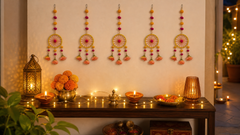
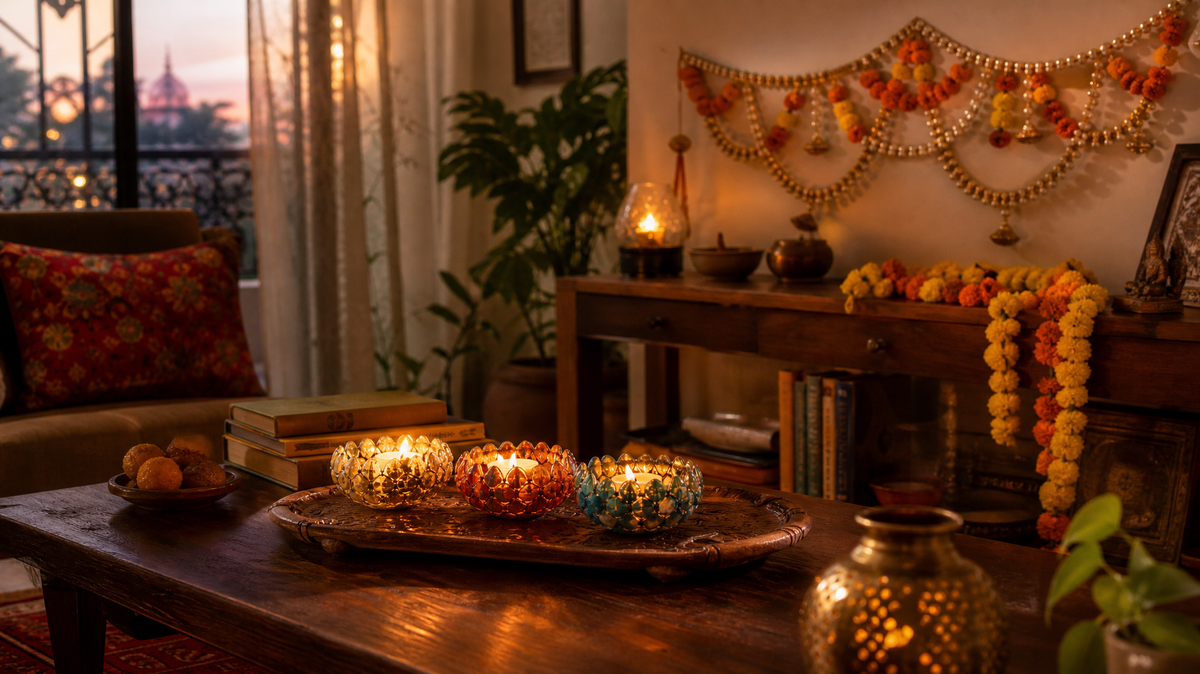
The toran is one of the most underused wall accessories in contemporary Indian homes. Traditionally hung above doorways to welcome guests and mark auspicious occasions, a marigold-and-pearl toran works just as well mounted above a console table or a sofa as a piece of living art. The combination of artificial marigolds and pearl detailing creates the layered, celebratory look that real flowers offer — without the daily upkeep. It signals festivity without requiring a festival.
The rule of thumb for wall accessories: one strong focal piece beats a cluster of small ones. Let it breathe.
Surface objects: the things that make a table worth looking at
Side tables, coffee tables, and console tops are the most over-decorated surfaces in most homes and the most under-thought. People pile things on them without considering what each object is actually contributing.
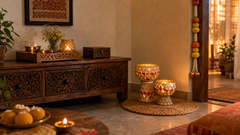
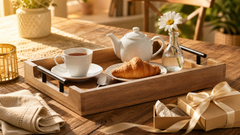
A surface object should do at least one of three things: add height variation, introduce texture, or tell you something about the person who lives there. A hand-carved wooden tray, for example, does all three at once. It groups smaller objects (a candle, a small plant, a book) into a composed arrangement rather than a scatter, it brings the warmth and grain of natural wood into a room that might otherwise be all smooth upholstery and glass, and it speaks immediately to a preference for handmade things over mass-produced ones.
The practical logic here: a tray on a coffee table isn't decoration for its own sake — it's organisation made beautiful. Everything on it looks intentional because the tray frames it.
Lighting accents: atmosphere is not an afterthought
This is the category most people skip entirely until they realise their living room feels clinical at 7 p.m. Overhead lighting is for function. Lighting accents — candles, holders, small lamps — are for mood.
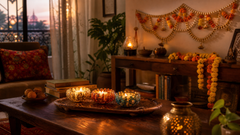
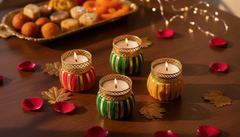
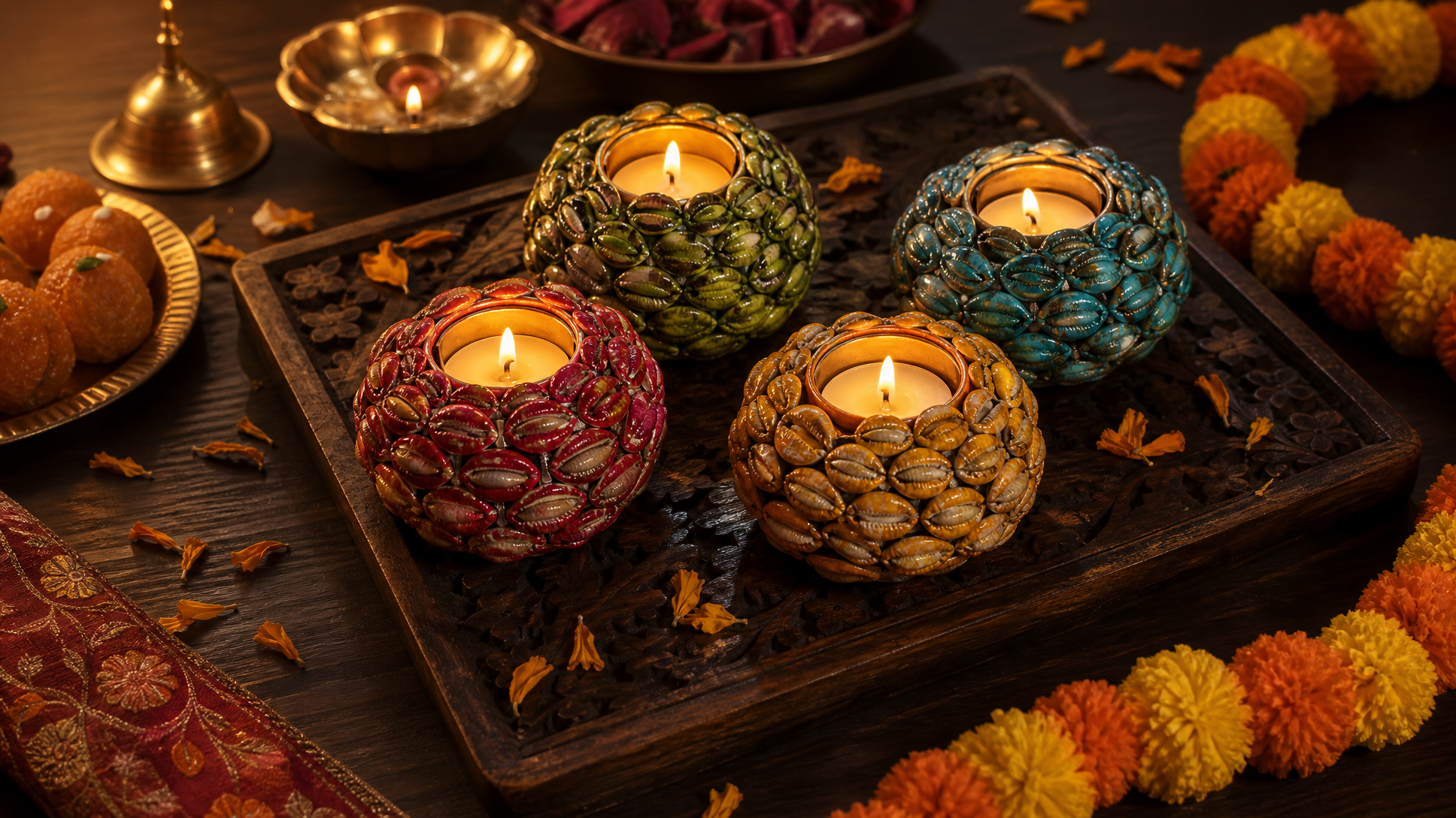
Tea light holders are one of the most effective and most affordable ways to shift the atmosphere of a room. The Indian craft tradition has produced extraordinary variations: shell holders that diffuse light with a warm, organic glow; carved stone holders that cast intricate shadow patterns on walls; painted clay holders that bring colour without permanence. A set of shell tea light candle holders arranged along a window ledge or clustered on a tray creates the kind of ambient warmth that no overhead bulb can replicate.
The key is placement. Lighting accents work at eye level when you're seated — on a low coffee table, a side table, or a window sill — not high up on a shelf where the light disappears into the ceiling.
Textile and hanging elements: softness and movement
Hard surfaces — wood floors, stone walls, glass tables — make a room feel sharp and echoey. Textiles counteract this. But in the context of Indian décor, "textile accessory" goes well beyond a throw blanket draped over a sofa arm.
Flower strings and garlands, traditionally associated with Indian festivals and puja spaces, have a natural home in the everyday living room when used with restraint. A single strand of artificial marigold garland looped along a bookshelf edge or draped across a mantelpiece introduces colour, movement, and a distinctly Indian warmth without turning your living room into a festival stall. The trick is treating it as you would any other textile accent: one deliberate placement, not several competing ones.
Hanging elements also add vertical dimension in rooms where wall art alone feels too static. The slight drape of a garland or the gentle weight of a beaded hanging creates a visual softness that framed prints simply can't.
The honest answer to "how many accessories is enough?"
More is almost never the answer. The rooms that feel most considered — most decorated rather than merely filled — tend to have fewer pieces, each doing a specific job. One wall anchor. A tray that organises the coffee table. Two or three tea light holders for the evening. A single garland length used deliberately.
Indian craft aesthetics can tip into maximalism easily, and maximalism done well is genuinely beautiful — but it requires discipline about repetition and restraint about colour. If you're starting out, start with one accessory per function. Add only when something is clearly missing.
If you're decorating for a specific occasion — Diwali, a housewarming, a family gathering — the same logic applies. A coordinated set of tea light holders and a toran above the entrance does more visual work than a dozen mismatched decorative objects scattered around the room. You can read more about thinking through gifting and occasion-based décor in our guide on what to gift a couple on Raksha Bandhan — the same principle of thoughtful, coordinated choices applies whether you're decorating for yourself or choosing for someone else.
The best living room accessories don't announce themselves. They make the room feel like it was always going to look this way — like the space simply couldn't have been otherwise. That's the standard worth decorating to.
Browse StoreIndya's living room accessories and find the pieces that do the most work in your space.
Frequently Asked Questions
What is the difference between living room décor and living room accessories?
Décor is a broad term that includes everything in the room — furniture, paint, flooring, and accessories. Accessories specifically refer to the movable, non-structural elements layered on top: candle holders, trays, wall hangings, garlands, and similar objects. They're the pieces you can rearrange, swap out seasonally, or replace without changing the room's bones.
How do I use Indian festive accessories like torans and garlands in an everyday living room without it looking like a decoration for a specific occasion?
The key is placement and restraint. A single marigold toran above a console table or sofa reads as a deliberate design choice rather than leftover festival décor. Similarly, one length of flower string draped along a shelf or mantelpiece looks intentional. It's when these elements appear in multiples, or in combination with every other festive piece at once, that a room starts to look occasion-specific rather than thoughtfully styled.
Are artificial flower garlands and torans suitable for permanent display, or are they only for festivals?
Artificial flower garlands and torans are well-suited to permanent or semi-permanent display precisely because they don't wilt or require water. Many people use them year-round as living room accents, refreshing them seasonally or when the colours fade. The practical advantage over fresh flowers is significant — the look stays consistent without any maintenance.
How many tea light holders do I need to actually create atmosphere in a living room?
There's no fixed number, but a cluster of three to four holders grouped together on a tray or surface tends to create more impact than the same holders spread across the room individually. Grouping concentrates the light and makes the arrangement feel composed. Placed at seated eye level — on a coffee table or low side table — even a small cluster can noticeably shift the mood of a room in the evening.
- festive décor
- handmade accessories
- home styling
- Indian craftsmanship
- Indian home décor
- living room décor